There’s a slip road onto the A23 near Handcross where almost every driver does the same thing: they floor it, nothing much happens, and they drop a gear. We hear about that moment a lot. Not because the car is broken, but because the engine is sitting on software written to keep a dealer network happy in forty different countries, and it has very little to do with how you actually drive between Horsham, Croydon and the M25.
Stage 1 tuning is the most common job we do, and it’s also the one people misunderstand most. So here’s a plain account of what it is, what it isn’t, and what you’ll notice on the way back from the shops.
What a Stage 1 remap actually is
Stage 1 is software only. Nothing bolted on, nothing taken off. We read the calibration already stored in your engine control unit, save that original file so it exists for the life of the vehicle, and write a revised calibration tailored to your engine, gearbox and condition.
Inside that file are thousands of lookup tables: how much fuel to inject and when, how much boost the turbo is allowed to make, how aggressively the torque limiters clamp things down in each gear. A manufacturer sets those conservatively. We adjust them with headroom left in, staying inside sensible limits for exhaust gas temperature, rail pressure and cylinder pressure. That’s the whole job. It’s why there’s no exhaust to buy and no intake to fit.
On a turbocharged engine, petrol or diesel, you’re typically looking at 20 to 30 percent more power and torque. On a naturally aspirated engine there’s far less to find, and we’ll tell you that before you book rather than after. No jargon and no overclaiming is not a slogan we hand out and then ignore.
Why the factory left it on the table in the first place
This is the question we get asked on nearly every driveway. If the engine can do it, why doesn’t it do it already?
A few reasons, none of them mysterious. Manufacturers sell the same block in several states of tune so there’s a model hierarchy and a price ladder. They have to account for fuel quality in markets where diesel is nothing like what comes out of a pump in Reigate. They build in a margin for owners who skip services for years. And emissions and economy figures are chased in very specific test conditions that bear little resemblance to a loaded Transit pulling out of a yard in Dartford.
Add all that together and there’s usually genuine room in the map. We’re not inventing power. We’re using what the hardware was always capable of, with the safety margin trimmed rather than removed.
Torque first: what it feels like from the driver’s seat
People fixate on peak power. Almost nobody feels peak power on a Tuesday morning.
What you feel is torque, and where it arrives. After a Stage 1 map, the car usually pulls earlier. The turbo comes on song lower in the rev range, so the flat spot that made you drop down a gear starts to fill in. In practice that means:
- Fewer gear changes in traffic and on hills
- Overtakes that need one decision rather than two
- A van that doesn’t feel like a different vehicle when it’s loaded
- Towing that stops being an exercise in momentum management
- Motorway cruising with the engine working less hard at the same speed
Tradespeople notice it most. A Sprinter or Vivaro with racking, tools and three jobs’ worth of materials in the back is a very different animal to the press demonstrator the factory map was signed off on. For fleet operators running several vans, we typically see fuel savings in the region of 10 to 15 percent alongside the extra pulling power, mostly because drivers stop flooring it to get anywhere.
Want figures for your own vehicle before you commit to anything? Enter your reg at vmaxtuning.co.uk and you’ll get instant guide power and torque numbers for that engine.
Stage 1 or Stage 2? The honest answer
Stage 2 gets talked about more than it gets fitted, in our experience. It’s a calibration written around supporting hardware that’s already on the car: a larger intercooler, a freer-flowing exhaust, sometimes a hybrid turbo. If the hardware isn’t there, a Stage 2 file is just a Stage 1 file with the sensible bits removed, and we won’t write one.
For the overwhelming majority of drivers in London, Kent, Surrey and Sussex, Stage 1 is the sensible choice. Standard car, standard servicing, standard fuel, a solid step forward in drivability. If you’ve genuinely modified your car and want to talk Stage 2, we’ll have that conversation properly, with the hardware list in front of us.
What actually happens on the day
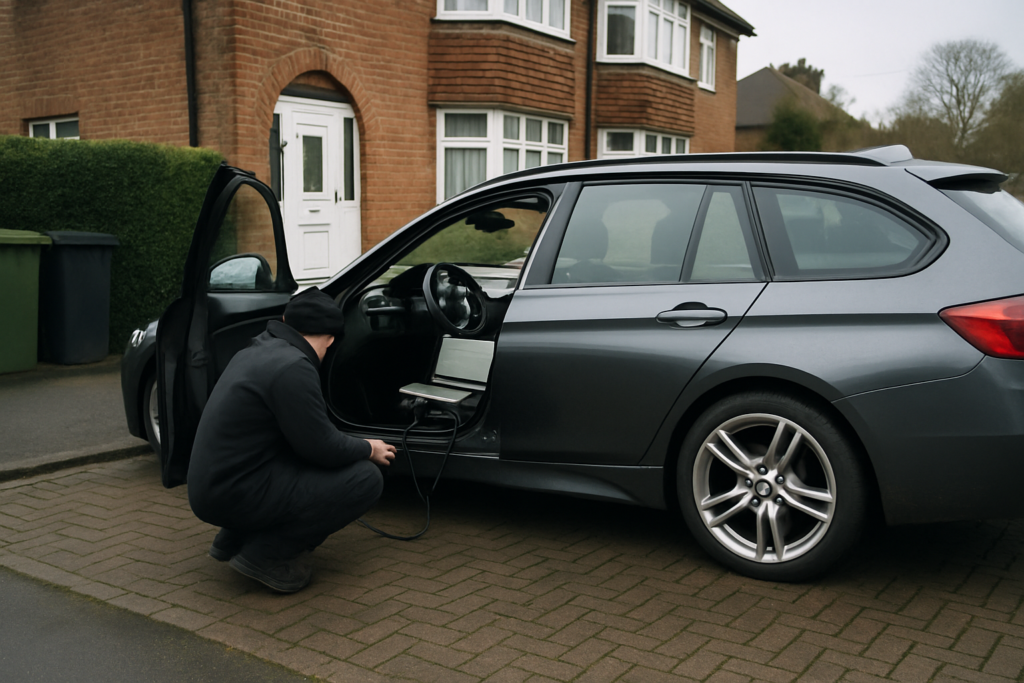
There’s no workshop to drive to. We come to your house, your office car park or your yard, which for most people is the difference between getting this done and leaving it on the list for another year.
A typical visit runs like this. The technician arrives with dealer-grade diagnostic and programming kit, Alientech, Autotuner and Magic Motorsport, and starts with a full diagnostic health check. That’s not a formality. If there’s a sticking EGR valve, a DPF that’s part way through a blocked regeneration cycle or a fault logged in the transmission module, we want to know before anything is written, and we’ll tell you if the car isn’t a sensible candidate.
Then we read the ECU, back up the original file, write the new calibration and run a second health check. A road test follows, on real roads, because a number on a screen isn’t the same as how a car behaves pulling away from a junction. You get a 30-day satisfaction guarantee and there’s no call-out fee.
Stage 1 starts from £250 all inclusive, covering the health checks, the calibration, the lifetime file backup and the road test. Larger engines can cost more, and the exact figure is confirmed in your quote rather than sprung on you on the driveway.
Is it safe for the engine?
Fair question, and the answer depends entirely on who’s writing the file. A map that chases a headline number by maxing out boost and fuel will punish a clutch, a DMF and eventually a turbo. One that respects the limits of the hardware won’t.
We check condition first, calibrate within sensible thermal and mechanical limits, and road test before we leave. We also keep your original file permanently, so if you ever sell the vehicle, trade it in or simply change your mind, it goes back to standard. Keep servicing it properly, use decent fuel, and a well-written Stage 1 map asks nothing unreasonable of the engine.
We cover Horsham, Crawley, Brighton and the Sussex coast, Guildford, Redhill, Reigate and Dorking across Surrey, all of Kent, and London, South London especially. Same-day and next-day visits are usually available, with evening and Saturday appointments for people who can’t lose a working day. For fleet work we’ll travel further.
Enter your reg at vmaxtuning.co.uk for instant figures, or ask for a free quote and we’ll reply within the hour in business hours. Prefer to talk it through? Call 0203 916 6478 for London and Kent, or 01293 850540 for Sussex and Surrey. WhatsApp works too.
